Thursday, September 8, 2022

IMMERSIVE MONET & THE IMPRESSIONISTS


IMMERSIVE MONET & THE IMPRESSIONISTS


On the 1st of September 2022, I found myself submerged, not in the water, but in the paintings of Monet and the Impressionists at the Lighthouse Artspace Chicago. The Show was  ‘Immersive Monet & The Impressionists’. As I stood in the center of the hall and proceeded to walk from room to room, I literally walked through the paintings of Monet, Renoir, Degas, Manet, Toulouse-Lautrec and Pissaro, and a few other Impressionists. When I stood on the upper floor and watched the paintings come to life on all the walls, the floor below, and the ceiling, it was magical, to say the least. In fact, when Monet’s ‘Water Lilies’was on display, I could see the water in the pond and the lilies on the floor, making me want to touch it. The highlight for me was looking at Monet’s ‘Impression Sunrise’ with the changing hues as one watched them on the walls. Monet’s ‘Woman with a Parasol’ most probably depicts Madame Monet and her  son, and ‘La Gare St.Lazare’ is a depiction of the Paris station, which Emile Zola described, “One could hear the hum of the trains and see the smoke overflowing into the galleries.” And that’s exactly what I felt- the train moving and the smoke coming out seemed to overwhelm the gallery. There were many great paintings of the other Impressionists, some of whom I could identify- Degas’s ‘Ballet Dancers’, Manet’s ‘Le Dejeuner sur l’herbe’, and Renoir’s classic ‘Bal du Moulin de la Galette’ which is a simple slice of life of the working class Paris. The use of light and color in all these paintings creates a movement in our minds which stay forever.


I had a similar feeling when in Paris I was at the Musee d’Orsay and as I stood there in the halls surrounded by the paintings of Monet, Manet, Renoir, Sisley, Cezanne, and other impressionists and Van Gogh it was a pilgrimage fulfilled for me.


There is so much to be said of Impressionism, but I would rather start with the words of Claude Monet, “It’s on the strength of observation and reflection that one finds a way. So we must dig and delve unceasingly.”


if you take the paintings of Claude Monet, he lays emphasis on the changing effect of light on the subject and visible brush strokes. This is very much seen in a series of paintings he made of the sunset called ‘Impression Sunrise’. It is from this painting that the word for the movement, Impressionism evolved. 


But perhaps the forerunner of Impressionism and the Expressionist movement in art is Turner (Joseph Mallard William Turner 1775-1851), Though he and John Constable (1776-1837) were exact contemporaries, their approach to depicting nature deferred. While Turner sought to capture emotion, perpetually aiming to be extraordinary, Constable sought to capture the grass, the skies, and the British countryside as it was, with its farms, churches, and bridges as they were. Turner was referred to as the Philosopher while Constable was the scientist. Turner preferred to paint outdoors and was so obsessed with natural illumination that his final words were, "The sun is God.”


If we look at the impressionistic painters such as Claude Monet we see the effect of Turner in the way they depicted nature. But you find their tones are much softer, but the similarity in style can be seen. The powerful and overwhelming nature of Turner, can be seen in the expressionists like Van Gogh.


The Impressionists like the Romantic landscape painters did not seek to control nature, they sought to capture the fascinating, ever-changing, and unpredictable moods of it through scale and treatment of space, brushstroke, and new relations of color to tone. They often sought to capture the sublime, with a strong emphasis on sensation ”.  The impressionist painter is concerned more with the visual impression of the moment, especially in terms of the shifting effects of light and color.


So it was, as I stood in the midst of all these moving paintings capturing the moments as seen through the eyes of the painter, I was transported to the sublime world of the artist having the quality of such greatness, magnitude, or intensity, that our ability to perceive or comprehend it is temporarily suspended.  To understand Sublime, I have not found a better painting than the painting ‘Wanderer above the Sea of Fog’ by Casper David Friedrich, the German Romantic artist. The painting draws attention to the smallness and insignificance of an individual in comparison to the untamed and possibly hostile natural setting. In it, one can even sense the immensity of the mysteries before us. When we stand on the shores and look across the oceans, we are struck with wonderment and also a sense of fear at the immensity before us. The awe is beyond definition. The same sense prevails when we look at the night sky, the stars, and the world beyond. One would want to merge with this immenseness. This is exactly how I felt. It was a sublime feeling standing in the midst and being transported into each of the paintings that were on display. 


Monday, September 5, 2022

FINDING MY CITADEL: MY MIRROR AND ME


BOOK REVIEW


FINDING MY CITADEL: MY MIRROR AND ME

by HARI BASKARAN

When I went through the Author's Bio I was amazed at what Shri Hari has achieved after attaining the age of 60 taking up cycling as a hobby and physical activity, culminating in a 250 km ride dedicated to children affected by cancer, to trekking in the Himalayas up to a height of 5000 meters. At the ripe age of 70, he went on a Cyclothon from Chennai to New Delhi a distance of 3000 km partnering with HelpAge India to inspire Senior Citizens. It has been necessary for me to summarize the author’s bio mainly because the reader will be able to understand and appreciate the person behind the book. Obviously, such a person has to be a leader and successful in the Corporate world where he spent most of his working life. When you read the book you travel along with him on his journey, his trials and tribulations, his overcoming self-doubt to faith in his abilities, and this sets him apart from the crowd.


Chapters 1 to 7 trace this aspect of his life. For me, the book really starts from Chapter 8 - Finding Me. It’s here his spiritual journey starts when he says that finding oneself is a lifelong journey to seek the divine within you. The passage - ‘The starting point of the journey is to have a deep desire to understand the fundamental questions of who we are and what is the purpose of our lives is explicit enough. One can understand his attitude to life ‘Every moment is an opportunity to learn and grow and then when we break out of an excessive concern for ourselves, and with innate compassion reach out to help as many people as possible, every moment of our lives is then an opportunity to create value and to sow seeds of happiness around us. Shri Hari Bhaskaran comes out as a very spiritual person and believes that the simple act of faith showed him the power of sincere prayers. He talks about Relative Happiness and Absolute Happiness and is a believer in NIchiren Buddhism and quotes from Daisaku Ikeda the third President of Soka Gakai that Prayer without action is just wishful thinking and action without prayer is unproductive.


In all, I would classify this book under the self-help category, written by a person who has seen both sides of the coin. Except for the fact that some misspellings have crept into the narrative, the book is a sincere attempt to bring out the lessons learned during his journey of life and share them with the reader so that it can be both helpful and a positive guide to self-actualization.


https://www.amazon.in/Finding-My-Citadel-Joy-Mirror-ebook/dp/B0BB7YWSBB/ref=sr_1_1?crid=9TYMJMBJ8FLX&keywords=finding+my+citadel+of+joy+my+mirror+and+me&qid=1662349629&sprefix=Finding+my+citadel%2Caps%2C197&sr=8-1


Saturday, August 20, 2022

SIGNS OF THE FALL?


I looked through the large arched window at the red of the Japanese Maple tree with the soothing green of the lawn spread in the background. From inside the house, it looked as though I was looking at a large landscape painting. My previous visits were during the Fall and going into Winter. This time we landed at the beginning of May in what is supposedly Spring - Summer, but we were welcomed by a cold, windy, and raining Chicago. Since then, there have been bouts of sunshine, rain, and thrice even a tornado warning. But for the past month, the weather has been warmer and even hot for a week reminding me of the weather we had left behind in Chennai. While here we were told that it is very hot and the weatherman (who is pretty accurate in his forecasts) warned that exposure would make one susceptible to heat strokes, I felt cold inside the house aching for the sunny outside. The best part of the day has been the morning walks around the neighborhood, feeling the tender warmth of the sun and gazing at the cooling green of the trees and the grass that embraced the surroundings. My wife and I enjoy this part of the day, for apart from the physical activity it is the peaceful surroundings that act as a massage for the mind (you come across only half a dozen people who greet you with a hello and pass you by). 


For the past few days, there has been a perceptible coolness seeping in, a nip in the air you may say, which we felt during the morning walks. Here and there the ground was strewn with yellow leaves, and as I looked at them a faint glimmer of hope arose that Fall could come earlier this year. Maybe it was my wishful thinking for the images of the Fall of 2018, when I was last here, are still fresh in my mind. Exhilarating as it was, Autumn has always reminded me of life’s glories and decadence; the leaves of the trees went through their complete cycle from several shades of green, then from yellow to orange, and finally to red and then brown. I reproduce a passage from my book ‘Autumn Leaves- Seasons of Life'


I watched as the leaves fell from the tree near the balcony, once green, then golden yellow, brown, and then on the ground. The tree stood barren and stripped; waiting for winter, to be covered white with snow, the rejuvenation in spring, and glory in summer to once again the fall. The cycle continues. Isn’t it very similar to the processes we undergo during our lives? Then would winter signify the hibernation we undergo after death to be rejuvenated and born again during spring? 


Usually, it is towards the second half of October that it starts and stays in full bloom till the first week of November. This time I knew I was going to miss it as I was due to return to India by the second week of October. But it was as if I was willing it to happen earlier so that I could carry back with me once again the images of life in its full bloom.


Today, as usual on my morning walk I was absorbed in the greenery and looking at each tree to see if there was a speck of color creeping in. All that I found were some leaves turned yellow, some brown lying around. Suddenly I saw a speck of what appeared to be a piece of colored paper on the path ahead. When I stooped to pick it up, I realized that it was a maple leaf. My joy knew no bounds as I looked at the various shades of green, yellow, red, and a small portion of brown. It was as if I was holding the whole of Autumn in my hand. I brought it back with me and placed in a copy of my book Autumn Leaves. I know the colors will fade, but that moment of joy will remain.


I would end this post with a quote from Stephen King


"But when fall comes, kicking summer out on its treacherous a** as it always does one day sometime after the midpoint of September, it stays awhile like an old friend that you have missed. It settles in the way an old friend will settle into your favorite chair and take out his pipe and light it and then fill the afternoon with stories of places he has been and things he has done since last he saw you." — Stephen King, Salem's Lot


Wednesday, July 13, 2022

THE MIRACLE THAT IS BABA


THE MIRACLE THAT IS BABA


In a previous post ‘The Silence of the Sage’ I had written about Ramana Maharishi, a great saint and a realized soul. His was the language of silence, the silence of the soul. The constant refrain in Maharishi’s path to Self-Realization is contemplating the question ‘Who am I’ and turning inwards to find the answer.

“More than the books about him what had an everlasting impact on my mind was the photograph and the eyes that spoke so much, that words were not necessary to commune with him. I remember I was so fixated on the glow in his eyes that I ended up sketching a portrait of him, and the minute I finished, I felt he had looked deep into my soul. That moment brought a satisfaction I had never felt before. I felt fulfilled.”


Much later, perhaps a decade and odd years later, I first came to know of another great saint who had lived in the town of Shirdi during the nineteenth century and early part of the twentieth century. Sai Baba was a fakir they said whose origins were unknown. There are many stories about him, that he was a healer and a miracle worker.


I was not in search of saints to solve my problems. It just happened, whether it be Ramana Maharishi or Sai Baba, that I came to know of them, the former when I was a child and the latter as a youth. Their impact on my life took its own time. It crept on me slowly but surely and by now it has completely absorbed me.


It was sometime during the winter of 1974 that I accompanied my brother and family on a road trip from Mumbai (then Bombay) to Aurangabad and Ahmednagar primarily to see the Ajanta and Ellora caves. On our way back to Nasik we had a brief stopover at Shirdi. It was late in the evening when we reached and proceeded to the samadhi of Sai Baba. For me then, it was just a part of the tour and we did not plan to spend much time there. Shirdi then was a small town and the Samadhi itself was a simple structure. There were not many pilgrims.  The dimly lit surroundings and the quietness prevailing lent an aura of sanctity and peace. We did not stay long and left for Nasik. 


Though at that time, for me Baba was just another saint among the many, in hindsight, I feel I carried something back with me which found its fruition many years later. Forty-eight years later as I sat down to write about what Baba means to me, I heard my grandson whistling in the next room the Arathi song of Sai Baba. Slightly taken aback, I went and asked what made him whistle the Arathi. He replied that it just came to him and for no particular reason. For me at that instant, it was as if Baba was urging me to write. You may call it a coincidence but to me, it was a sign, one among many that I have experienced over the years.


This post is not about the story of Baba or his miracles. There are enough books written on these and I do not feel qualified to write about them. Mine is just experiential. Some may dismiss it as coincidences and once upon a time even I had judged them so, whenever I heard or read people narrating their own experiences. Ultimately, it is all about faith and that is an aspect that made a doubter into a believer. You may ask how come this transformation? Well, that’s where my story begins.


What are we without faith, 

A rudderless ship on stormy seas! 

In search of hands to steer us through, 

In a quest to reach that distant land, 

of promised calm and peace,

To place our faith in his hand

To cross the turbulence of the stormy seas.


So, what are we without faith but a rudderless ship on a stormy sea?


The first sign appeared (which then did not in any way alter my perception of Gods and Gurus except that they were there for people to cling on to escape the reality of life) one afternoon as I fell asleep on the couch next to the window. I don’t remember what I dreamt, but that afternoon I was in a pensive mood wondering about my future and what lay in store. This was soon after my visit to Shirdi. I was woken up by something falling on my chest. I woke up to find that the postman had just thrown an envelope through the window and it had fallen on me. It was addressed to me and as I read the letter stating that I had been successful in the State Bank probationary officer’s test and asking me to appear for the interview for final selection. At that time I felt no connection, they were isolated incidents.

It was only much later as I sat down to recollect, after certain incidents which I could not dismiss as coincidences, that I felt the connection.


Baba drew no distinctions and did not preach or recognize religion. Anyone who came to him was equal in all respects. This was what drew me to him. Like Ramana Maharishi, to him the realization of the self is paramount. Discarding attachment to worldly things and concentrating on doing your duty echoes the Bhagavad Gita. His was a simple philosophy of love and forgiveness, charity and contentment. 


While Ramana Maharishi stressed asking the question ‘Who am I?’ to take one on the path to self-realization, the two cardinal principles of Baba’s philosophy are Shraddha (love and reverence) and Saburi (Patience and perseverance). These two are enough and a must for an individual to overcome obstacles in the course of one’s life and move towards a state of realization. 


I have always believed that there are no miracles and that things do not happen the way we want them. There are no shortcuts; one has to undergo the full play of life, the way of destiny. Well, that is an easy way of shifting the onus for the ills in your life. No one knows the future, destiny is an afterthought when you find yourself unable to tackle the problems of your present. So how does one tackle the present? Accept the reality of the present and move forward and the future will take care of itself. This is where Baba becomes so relevant. Shraddha and Saburi in the conduct of one’s life will help you to accept, understand and overcome and that’s where the miracle happens. You are no longer attached to your present and will find it easier to move forward without regrets.  


As I moved from place to place and house to house, I would always find a Sai Baba temple nearby, given the fact that over the years since my first glimpse of Shirdi the devotees of Baba had increased manifold and temples had sprung up all over, it was nothing strange. Without fail, on my morning walks around the neighborhood, I would stop by a Baba temple, go inside, say a short prayer and resume my walk. There was nothing intense about it since it had become a part of my morning routine. There was no deep devotion. But it slowly happened and I felt uneasy if I missed the routine. Slowly I felt myself being drawn into his fold. I did not pray because I wanted something to happen, it was just the sensation of peace and fulfillment when I stood in front of Baba’s idol. 


It happened slowly as I started looking up to him for support during times of personal crisis, whether it be concerning my health or anxiety. As always, I did not expect miracles to solve my problems, but I soon found that things would get sorted out. Faith in Baba had helped me face and overcome these situations. Maybe not all my problems were solved, but faith gave me the necessary strength to face and accept the outcomes. 


There have been certain incidents that I have not been able to comprehend or dismiss as coincidences. These have invariably happened during my daily meditations. To narrate two of those intriguing happenings - as I sat in meditation one day the question crept in whether all this was a futile exercise and whether Baba had heard me. Precisely at that moment, the clock started ringing, though the alarm was set for 6am. It was strange for the time on the clock showed 10 am. Well, you can always say that it was a malfunction and a coincidence, but for me, it was a sign.


The second incident was even more intriguing. As I sat in meditation that day in a disturbed state of mind, I received a phone call from a friend. He said that he had just come back from Shirdi and brought something to give me. It was a scarf worn around the head of the Sai Baba idol at Shirdi. He further added that when he stepped out of his home to go to the office in the morning, something urged him to give the scarf to me. He sent it later in the day to me. To this day I have the scarf at home. 


It is very easy to label these as coincidences, but for a man of faith, it is a sign.


It’s not my aim to indoctrinate or sermonize. Sai Baba’s philosophy is universal, embracing all religions, believers, non-believers, and those who doubt. It is all about faith, patience, perseverance, and commitment to the conduct of one’s life. Baba does not promise miracles, but he is there to lend his hand to pull you out of entanglements that life weaves around you. And that is a miracle.  Yes, Baba is a healer and a miracle worker.


Through all the trials and tribulations that life throws, there is a silent confidence that Sai Baba is there to take care of me. 


Tuesday, June 28, 2022

THE CLOCK


THE CLOCK or TIME?


I should acknowledge the role and contribution of my grandson in making this post possible. I had not written for a long time and one excuse was that my laptop had become very slow and in fact, it was crawling. I recognized that it was at the end of its tether. But perhaps the more important point, I was at a loss as to what to write. So I let my laptop, which had become too heavy for me to carry, lie where it was, back home in India. It has been with me on my journey through all five books and I thought it was time to give him some rest. So, he must be back there, wondering how I was coping without him for company. It was difficult, so I thought of getting him a younger companion. Please note that it has never been my intention to (dump him). But with my growing years and slowing speed, I had no choice. So I bought myself a Chromebook which I thought would serve my purpose, lighter to carry, and of course lighter on the purse. This needed a reorientation and that’s where my grandson comes in. All of ten years old, he taught me the basics of all the control functions on the keyboard, he the teacher, and me the student, separated by six decades. That perhaps was the defining factor between the new Chromebook and my old Laptop. 


Having finished teaching me the basics, he asked-


"Grandpa, what are you going to write about?”


“Well, it’s been such a long time since I wrote something, I am still at a loss what to write about,” I replied.


“Oh! But there are so many topics you can write on,” he said.


“Can you suggest one, since you seem to have something in your mind?”


“If you can write about your conversation with a cat, why can’t you think of a conversation with a clock?” he laughed.


For a moment I fell silent. That was a wonderful suggestion I thought and offered immense possibilities. He added that time is an undefined cosmic element that is relative in nature (I don’t know from where he had picked this up) and ended by asking me to add Philosophical humor. I was flabbergasted, a child barely eleven years old suggesting this. It made me feel proud, but left me gasping. 


“Well, that’s a good one, I think I shall do it, Thank you,” I said.


Easier said than done. I realized it when I started to write. My grandson looked over my shoulder and said-

“Grandpa, are you going to write about the clock or time?” he asked.


“Why do you ask? Aren’t both the same?”


“I just asked,” he replied.


MY CONVERSATION WITH THE CLOCK


For some time now I’ve been having conversations with non-human entities, be it my beard, the chair, or the cat. It always happens after midnight when the others are fast asleep. You may even call it my nocturnal excursions, but I should admit that I have found these conversations profound and elevating, at the end of which I have been left pondering. 


Last night, it was the Clock. At the stroke of midnight, the grandfather’s clock in the room chimed. For the first time, I heard its booming sound, something I had not paid much attention to till now, and taken it for granted as a part of the paraphernalia. But last night it was different. It sounded unusually loud and I was sure no one else in the house heard it. It appeared that this was for my ears only, and as if it was beckoning to me. So I got up and went down to the living room and stood in front of the clock and stared at it. 


“Well, well, I see you heard my call and came down here. Let me assure you that it was for your ears only, the others are fast asleep in their beds. For a long time now (well that is what I keep isn’t it, marking time) I have felt the need to talk and who better than you to listen. I have been witness to your midnight conversations with the chair, the cat, and even your beard and thought you were the best person to whom I could unburden my innermost thoughts,” he said. 


I could no longer refer to the clock as ‘it’ for it sounded very much human. I continued to stare at him, not having recovered from the shock of listening to a clock. 


“Why are you standing there staring at me? It will be some time before we finish our talk (assuming you will respond). So why don’t you pull up a chair and sit, and make yourself comfortable. After all, you are still the master of this house,” he continued.


“Sorry, that was an initial shock since I thought you folks usually went ‘tick-tock’ or ‘ding dong’”, I replied, pulling up a chair and sitting in front of him reconciling to the fact that it was going to be a long night ahead.


“Ha, ha, that’s our native lingo, but it does not mean that we cannot converse in a different tongue. See I have been listening to you people for such a long time, in fact for decades, that it is but natural I pick up your language. In fact, I am quite fluent and could teach you a thing or two,” he said.


“But do you realize?” he continued, “it is that same tick-tock and ding-dong with which I have kept track of your life, your growing up and growing old. All your past and present is already here and your future also belongs to me. Your whole life is contained within my domain. I was then, I am here and will continue to be.”


“That cannot be. You must have a beginning and an end just like us mortals. I have aged and so have you. Maybe your life span is greater, but you have to acknowledge that when you run out of energy because your pendulum has stopped since it is too tired, you require my intervention to start you off once again. So you are as mortal as I  am. You have a beginning and an end,” I said.


“Well, there’s a catch. If you are talking about my physical manifestation, yes. I came into your home a hundred and fifty years ago when your great grandfather bought me from one of the renowned clock makers in the town. He was impressed by my grand looks. I am awake to the possibility that you may decide to sell me off as scrap. That will only bring to an end my physical existence. But whether I tick-tock or not, whether you keep resetting me or not or sell me off as scrap, you can never take Time away from me for that is my Essence. You will agree that you cannot live without my essential Being, that’s why you keep resetting me to keep track of your present existence,” he replied.


“That’s ok, but isn’t re-energizing and resetting you, is like reincarnation,” I asked. 


“That’s a thought and a good one. But it’s interesting that you talk of reincarnation. So you do believe in it?” he asked.


“Well, it’s a comforting thought isn’t it?”


“It is. For me, there is no reincarnation. I am always and will always be,” he said.


“Scientists say that you started with the Big Bang, what do you have to say to that?” I asked.


“Ha, they say a lot of things. They even say I will end with the Big Crunch. I am not bothered by what they say, maybe you understand them better. But let me tell you that there have been many Big Bangs and Big Crunches. I have been through them all. They will continue that’s how this universe functions. You know Space? You should have a talk with him someday. He is everywhere, all-encompassing, and I am there with him always. We both determine the reality of your existence, all your past, present, and future.” 


How could that be possible? I thought. I have seen the years pass me by, from a child to youth and now an old man. Physically I have grown and changed, as age catches up I find myself deteriorating, and one day I will break down into non-existence. When someone says the time has flown, so many years have passed. And that is time, isn’t it? I cannot accept that my future is already known when it has not happened. 


“If as you claim that my future is known, can you tell me about it?” I asked.


“Oh! That is a cosmic secret and will remain so. I can’t help you even if I want to,” he replied.


“That’s being evasive. Why don’t you accept that you don’t know because it has not happened?”


“Whatever. Can you tell with certainty when the universe began? You can only speculate. While one says that everything including me started with the Big Bang and another says I am an illusion, whom will you believe? The more you think that you have found the answer more questions arise. The truth is The Truth is out there. I am there and so is Space. There are no boundaries,” he replied.


By now I was totally confused. Everyone talks about The Truth but when it comes to answering they say it’s the Absolute, All-encompassing, the Brahman, and so on. The only thing they say is that what I conceive as change from past to present and future is only in respect of my physical manifestation but beyond that, is my Essence, which is always there, indestructible. I knew I was treading into realms that seemed out of bounds for an ordinary man like me who accepts that I begin and that I end. But it is indeed a comforting thought ‘You may sell me off as scrap but you can never take Time out of me for that is my Essence'.


“Well I can sense that you are getting somewhere, but I can also see your eyelids droop. Feeling tired, bored, or sleepy? In any case, it’s ‘Time’ you went to sleep,” he said.


“I guess that I am all three - tired, bored, and sleepy,” I replied.


“So should I say good night or good morning,” he asked.


“Whatever,” I replied and started to move.

I am sure that I heard him chime as if to say ‘bye’.


It was around eight in the morning when I was woken up by my grandson. As I opened my eyes, I found him staring at me.


“Grandpa, did you finish writing your blog?” he asked.


“I hope so. Well let us see,” I said.


There it was, my first post on my new Chromebook. 


“Let me read it,” he said and proceeded to do so.


“But grandpa, I cannot understand anything you have written,” he said.


I smiled at him and said, “neither do I”.


Tuesday, March 8, 2022

A NEW AVATAR

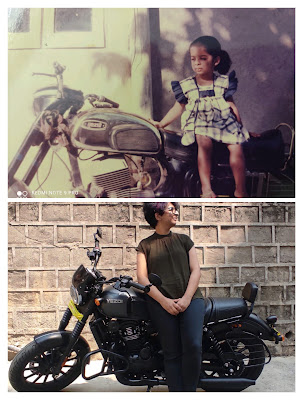
 I reproduce an excerpt from my book ‘I am just An Ordinary Man’ where I talk about my association or rather the relationship I shared with my motorbike. Later, when I read Pirzig’s ‘Zen and the Art of Motorcycle Maintenance’ I could fully relate to what I shared with it. It had become a member of the family so much so that my daughters also shared the same feeling. Today when I read my younger daughter’s what I would call A Motorcycle Diary did I fully realize the impact it had on her growing up. I thought that I should share this on my blog because it sensitively recreates those years and the reality of the present. It was all the more amazing that she wrote it all, sitting in the showroom waiting to take delivery of what she calls the new Avatar, a memory reborn.

‘My longest association has been with my motorcycle which was with me for nearly twenty-two years. It was a year older than my elder daughter, so she did travel in my wife’s arms on the pillion till she was old enough to sit between us. That went on for five years till my second daughter was born. After this, my wife had to manage with the elder one sitting between us and the younger one in her arms. This carried on till the younger one was old enough to sit on the petrol tank. We made a pretty picture, the four of us. This went on till my younger daughter’s hair grew long enough to obscure my vision as I rode the bike.’


A MOTORCYCLE DIARY

A few years ago, when my partner was eyeing an old revived classic bike with mixed emotions, I promised, if Yezdi ever comes back, we are getting one. I have seen him pining, even as he calls it an unnecessary indulgence and an encroachment of space in our lifestyles. 

Both our dads had Yezdis and my loyalty to it was cemented since the time I was tiny enough to fit on the petrol tank and pretend I was the one in control. That was my space, my place, and no kid ever came close to taking that away from me. 

As I sat and watched my dad tinkering away on the motorcycle, explaining spark plugs and engine parts and exhaust, to a six-year-old me, I dreamt of a day when I could be big, strong, and smart as dad and drive and care for a monstrous motorcycle. But more than my grandiose daydreams, my love for the thing was born out of a feeling of being protected and a feeling of home. 

For a little girl anxious to get away from the maddening crowd, there are no sweeter words of comfort than "your dad is here to take you home".

In a world before smartphones and GPS tracking, there is no sweeter sound than the dhub dhub dhub of his steed that lets you know he is just a mile away. 

But the absolute ace was the feeling beneath your feet that accompanied the sound. The reverberating drum that calmed your racing mind with the promise of home. 

Silent tears were shed behind closed doors when my dad decided to sell the old boy after all those years, making way for changing lifestyles. Today, when the legend is back home in a new avatar, there will be tears, but no one will talk about it. I may not be the anxious kid, I once was but I still have no chill or the muscle tone required to ride the monstrous motorcycle. I am not tiny anymore to sit on the petrol tank, but I still have my memories of comfort and security.

Thursday, February 10, 2022

THE SILENCE OF THE SAGE – RAMANA MAHARISHI


THE SILENCE OF THE SAGE – RAMANA MAHARISHI

“Who is that,” I asked my father, pointing at a photograph in the puja shelf, one among many there. What attracted my attention was that out of all the pantheon of Hindu God pictures in the shelf this was all too human – that of an old man with benign eyes and a graceful smile. The photograph had been there always but this was the first time I was drawn to notice it. I was a boy ten years old. The puja shelf was filled with images of various Gods. At that age, I could relate to most of them from the stories told me by my parents and the numerous temples which we visited and offered prayers. It didn’t matter there were so many of them, after all, they were our guardians and they were our Gods.

“That is Bhagwan Ramana Maharishi,” my father replied.

“What is a Maharishi?” I asked

“He is someone who is full of wisdom,” my father replied.

“Is he a God also?” I asked.

“Some believe him to be so, but that does not matter. He is a Sage who lived in Tiruvannamalai. Now his ashram is situated where he lived at the foothills of the sacred Arunachala hill,” my father replied.

At that age, I did not have further questions to ask, for I assumed since he was in the Puja shelf, he was also a God. Ever since Ramana Maharishi became a constant figure in my metaphysical meditations. As the years passed, I came to know more and more of him from the various books written about him and his philosophy.

More than the books about him what had an everlasting impact on my mind was the photograph and the eyes that spoke so much, that words were not necessary to commune with him. I remember I was so fixated with the glow in his eyes that I ended up sketching a portrait of him, and the minute I finished, I felt he had looked deep into my soul. That moment brought a satisfaction I had never felt before, after finishing a sketch or a painting. I felt fulfilled.

The constant refrain in Maharishi’s path to Self-Realization is contemplating on the question ‘Who am I’ and turning inwards to find the answer. The first few lines in my book ‘I am just An Ordinary Man’ express my dilemma and feelings of inadequacy in trying to answer this - “Sir, you asked me who I am. What shall I say? I have been asking myself this question for quite some time and reached nowhere. After all, I am no saint to throw away everything that I have and go in search of an answer. If I had, I would have been a saint. Don’t you agree?

It is always enlightening to read the experiences of aliens to our culture. People who have come to sincerely understand our philosophy, culture, religion, and the secrets that define who we as a people are. Their views and findings are bound to be more authentic and critical when they come with an open mind freed of the prejudices that had been painted in their minds of a country of snake charmers, faqueers, fake magicians, and fake godmen who hold sway over a gullible population There have been many who have written on Eastern Philosophy which has been more academic than experiential. Our own accounts are bound to be influenced by the familiarity with the secrets of the land we have been born in.

Of all the books I have read about Ramana Maharishi, two stand out – ‘A Search in Secret India’ by Paul Brunton and a number of books by Arthur Osborne on the Teachings of Ramana Maharishi. Both of whom stayed back to be in the close proximity of Ramana Maharishi, since they found in him the Great Master.

‘Remote from the haunts of men, deep in the jungles to which- or to the Himalayas- the holiest men in India always return, Mr. Brunton found the very embodiment of all that India holds most sacred, The Maharishi- The Great Sage- was the man who made the most appeal to Mr. Brunton.’ From the foreword to the book.

From the book ‘A Search in Secret India’ in Paul Brunton’s own words-

‘I can say only that in India I found my faith restored. Not so long ago I was among those who regard God as a hallucination of human fancy, spiritual truth as a mere nebula, and providential justice as a confection for infantile idealists. I, too, was somewhat impatient of those who construct theological paradises and then who confidently show you round with an air of being God’s estate agents. I had nothing but contempt for what seemed to be the futile, fanatical efforts, uncritical theorizers.’

‘This faith was restored in the only way a skeptic could have it restored, not by argument, but by the witness of an overwhelming experience. And it was a jungle sage, an unassuming hermit who had formerly lived for six years in a mountain cave, who promoted this vital change in my thinking.’

Nothing describes ‘The Silence of the Sage’ then Brunton’s first interaction with the Maharishi-

‘There is something in this man, which holds my attention as steel filings are held by a magnet. I cannot turn my gaze away from him. My initial bewilderment, my perplexity at being totally ignored, slowly fade away as this strange fascination begins to grip me more firmly. But it is not till the second hour of the uncommon scene that I become aware of a silent, resistless change that is taking place within my mind. One by one, the questions which I have prepared with such meticulous accuracy drop away. For it does not now seem to matter whether they are asked or not, and it does not seem to matter whether I solve the problems which have hitherto troubled me. I only know that a steady river of quietness seems to be flowing near, that a great peace is penetrating the inner reaches of my being, and that my thought-tortured brain is beginning to arrive at some rest.’

I have chosen to talk about Paul Brunton because his is a fascinating search through the length and breadth of our country to find the real master through this labyrinth of holy men, some self-styled and some genuine, who could guide him in understanding Yoga and the purpose and meaning of life. His meeting with the Paramacharya of Kanchi himself a great sage, is the turning point in this search, for it is he who directs him to meet Ramana Maharishi. When Brunton asks him where he can find the real master, Paramacharya tells him –

“He lives in the interior, farther south. I visited him once and know him to be a high master. I recommend that you go to him. He is called the Maharishi. His abode is on Arunachala, the Mountain of the Holy Beacon. Promise me that you will not leave South India before you have met him.”

After meeting Ramana Maharishi for the first time Brunton continues his travels throughout the country and ultimately returns to the abode of the Maharishi for in him, he is convinced he has found the true master.

“Again and again, I become conscious that he is drawing my mind into his own atmosphere during these periods of quiet repose. And it is at such times that one begins to understand why the silences of this man are more significant than his utterances. His quiet unhurried poise veils a dynamic attainment, which can powerfully affect a person without the medium of audible speech or visible action.”

Since I Paul Brunton’s words have struck a chord and deep inside me, something stirs when I look at the picture of this great sage. The eyes say so much, so much compassion and so much silence. This silence speaks directly to the soul.

I have been to Tiruvannamalai years ago. I have had the opportunity of experiencing the silence and stillness in the hall where once the Maharishi sat gazing into infinity at the same time looking into the soul of every person assembled there just to be in his presence. The Arunachala hill stands behind, as silent and still as the Maharishi, a beacon lighting up the darkness in our lives.


THE INHERITANCE OF SOLITUDE

  THE INHERITANCE OF SOLITUDE by SMITHA VISHWANATH In her poem ‘The Inheritance of Solitude’ Smitha says - I understand now when on my own I...